Die Bedeutung der Güteauswahl in der Lebensmittelindustrie
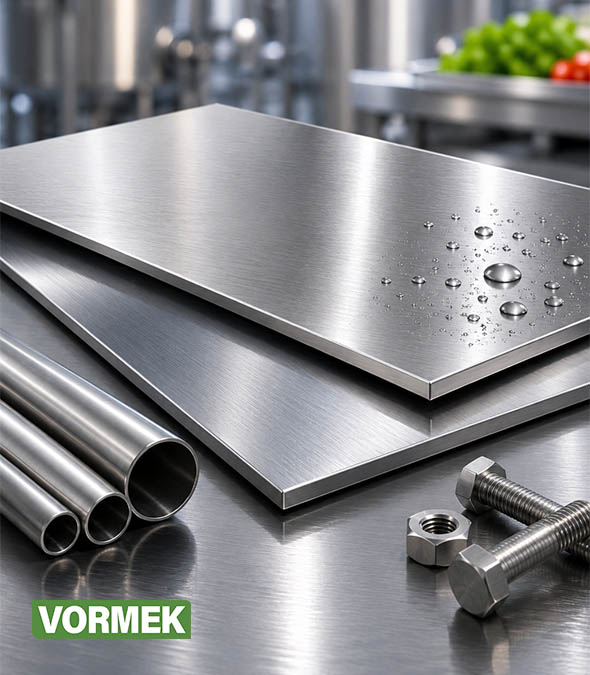
In der Lebensmittelverpackungsindustrie stellt die Materialauswahl für die Gerätekonstruktion eine der kritischsten technischen Entscheidungen dar, die sich direkt auf Haltbarkeit, Lebensmittelsicherheit und Betriebskosten auswirkt. Nichtrostender Stahl (Edelstahl) dient aufgrund seiner außergewöhnlichen Korrosionsbeständigkeit, geeigneten mechanischen Festigkeit, hervorragenden Oberflächenbearbeitbarkeit und Konformität mit Hygienestandards als primäres Material für Lebensmittelverarbeitungs- und Verpackungsmaschinen. Unter den zahlreichen verfügbaren Edelstahlgüten sind die austenitischen Güten 304 und 316 aus der 300er-Serie die am häufigsten in der Lebensmittelindustrie verwendeten.
Trotz ihrer erheblichen strukturellen Ähnlichkeiten führen Unterschiede in der chemischen Zusammensetzung zwischen diesen beiden Güten zu erheblichen Abweichungen in der Leistung, Korrosionsbeständigkeit und Anwendungseignung. Eine falsche Güteauswahl kann schwerwiegende Folgen haben: von vorzeitiger Korrosion und Produktionslinienstillständen bis hin zu exorbitanten Reparatur- und Austauschkosten. Umgekehrt führt eine übermäßig konservative Auswahl – die Verwendung von 316, wo 304 ausreichen würde – zu unnötigen Investitionsausgaben.
Dieser Artikel bietet einen umfassenden technischen Leitfaden für die Auswahl zwischen den Güten 304 und 316 in Lebensmittelverpackungsmaschinen. Basierend auf internationalen Normen, wissenschaftlichen Daten und praktischer Industrieerfahrung unterstützt dieser Leitfaden Konstruktionsingenieure, Produktionsleiter und Geräteeinkäufer bei fundierten, optimalen Entscheidungen.
Die Lebensmittelverpackungsindustrie operiert unter einigen der strengsten Hygiene- und Sicherheitsvorschriften weltweit. Geräte müssen häufige Reinigungen mit aggressiven Reinigungsmitteln, die Exposition gegenüber sauren oder salzigen Lebensmitteln und kontinuierliche mechanische Beanspruchung aushalten. Die Wahl der Edelstahlgüte beeinflusst direkt, wie gut Geräte unter diesen anspruchsvollen Bedingungen funktionieren. Die Nuancen zwischen 304 und 316 zu verstehen, ist keine bloße akademische Übung – es ist eine praktische Notwendigkeit für die Gewährleistung langfristiger betrieblicher Zuverlässigkeit und regulatorischer Konformität.
Überblick: Edelstahl 304
Chemische Zusammensetzung und Struktur
Edelstahl 304, auch bekannt als “18/8”, gehört zu den weltweit am häufigsten verwendeten Edelstahlgüten. Seine chemische Zusammensetzung umfasst etwa 18–20 % Chrom und 8–11 % Nickel. Das Vorhandensein dieser Elemente schafft ein optimales Gleichgewicht zwischen Korrosionsbeständigkeit, Festigkeit und Umformbarkeit.
Im geglühten Zustand ist diese Legierung nicht magnetisch, was sie für Branchen geeignet macht, die empfindlich auf Magnetfelder reagieren. Ihre austenitische Struktur bietet hervorragende Umformbarkeit und Schweißbarkeit – Eigenschaften, die sie zu einer idealen Wahl für die Herstellung komplexer Geräte und Tanks machen.
Der Chromgehalt in 304 bildet auf der Oberfläche eine passive Oxidschicht, die den primären Korrosionsschutzmechanismus darstellt. Diese Schicht ist selbstheilend – wenn sie zerkratzt oder beschädigt wird, regeneriert sie sich in Gegenwart von Sauerstoff. Der Nickelgehalt stabilisiert die austenitische Struktur und verhindert die Umwandlung in andere Phasen, die die Korrosionsbeständigkeit oder mechanischen Eigenschaften beeinträchtigen könnten.
Mechanische Eigenschaften
Edelstahl 304 bietet eine Streckgrenze von etwa 170 MPa (25 ksi) und eine Zugfestigkeit von etwa 485 MPa (70 ksi) mit einer Dehnung von etwa 40 % in 50 mm. Das Material zeigt eine gute Bearbeitbarkeit und ausgezeichnete Schweißbarkeit. Seine maximale Dauereinsatztemperatur erreicht etwa 870 °C, während die minimale Einsatztemperatur bis -196 °C reicht.
Edelstahl 304 weist eine ausgezeichnete Beständigkeit gegen die meisten oxidierenden Säuren auf, und seine polierte Oberfläche ist leicht zu reinigen – Eigenschaften, die ihn zu einer idealen Wahl für Küchenanwendungen und Lebensmittelkontaktoberflächen machen.
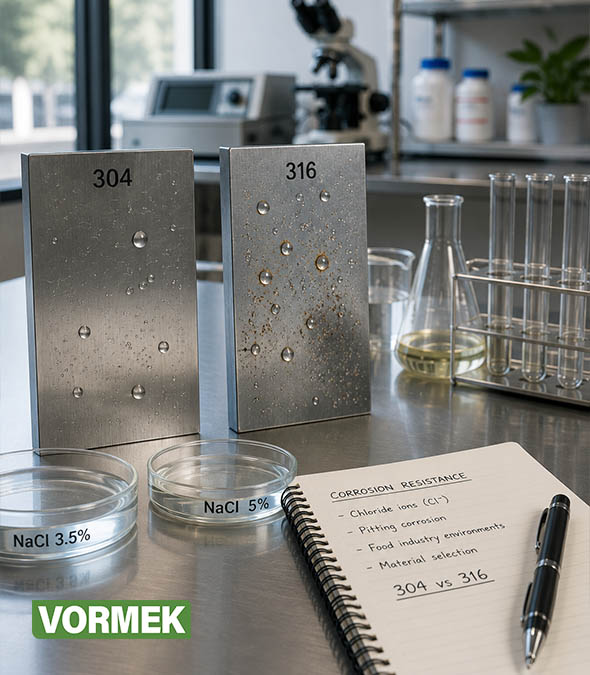
304 ist jedoch anfällig für Lochfraßkorrosion in Umgebungen, die Chloridionen enthalten, wie Meerwasser, Salzlösungen oder salzigen Lebensmitteln. Lösungen mit Natriumchloridkonzentrationen von nur 25 ppm können bei dieser Güte Lochfraß auslösen. Daher werden in Meeres-, Küsten- oder salzreichen Lebensmittelverarbeitungsanwendungen beständigere Güten empfohlen.
Sensibilisierungsphänomen
Eine der kritischen Einschränkungen von Standard-304 ist seine Anfälligkeit für Sensibilisierung bei Temperaturen im Bereich von 425–860 °C. Während dieser Temperatureinwirkung fallen Chromcarbide an den Korngrenzen aus und verarmen die angrenzenden Bereiche an Chrom. Diese Verarmung reduziert die lokale Korrosionsbeständigkeit und macht das Material anfällig für interkristalline Korrosion.
Das Sensibilisierungsphänomen ist besonders relevant für Schweißanwendungen. Die wärmebeeinflusste Zone neben der Schweißnaht kann Temperaturen im Sensibilisierungsbereich erfahren, was möglicherweise die Korrosionsbeständigkeit im Betrieb beeinträchtigt. Aus diesem Grund wurden kohlenstoffarme Güten wie 304L (mit maximal 0,035 % Kohlenstoff) entwickelt, um die Carbidausscheidung zu minimieren.
Häufige Anwendungen
Aufgrund seines hervorragenden Kosten-Nutzen-Verhältnisses wird Edelstahl 304 in einer Vielzahl von Lebensmittelindustrieanlagen verwendet:
- Allgemeine Lebensmittelverarbeitungsanlagen einschließlich Tanks, Schüsseln, Rohrleitungen und Maschinenkomponenten
- Industrielle Küchenoberflächen wie Arbeitsplatten, Spülen und Tresen
- Lager- und Kühlgeräte
- Molkerei- und Brauereianlagen einschließlich Gärtanks
- Küchenutensilien und Kochgeschirr
- Verpackungsmaschinen-Außenverkleidungen und Schutzplatten
- Getränkeverarbeitungstanks und -rohrleitungen für nicht-saure Getränke
- Bäckereiausrüstung einschließlich Mischenschüsseln und Ofenkomponenten
Überblick: Edelstahl 316
Chemische Zusammensetzung und Struktur
Edelstahl 316 ist strukturell 304 sehr ähnlich, aber der Hauptunterschied liegt in der Zugabe von etwa 2–3 % Molybdän (Mo) zur Legierungszusammensetzung. Diese Güte enthält typischerweise 16–18 % Chrom und 10–14 % Nickel.
Das Vorhandensein von Molybdän erhöht die Korrosionsbeständigkeit erheblich, insbesondere in chloridhaltigen Umgebungen, was 316 die Bezeichnung “Marine Grade” einbrachte. Seine austenitische Struktur bietet wie 304 eine gute Umformbarkeit und Schweißbarkeit, obwohl die Bearbeitung aufgrund höherer Kaltverfestigungsraten anspruchsvoller ist.
Molybdän verbessert die Stabilität des passiven Oxidfilms in Gegenwart von Chloriden. Es verbessert auch die Beständigkeit gegen Lochfraß und Spaltkorrosion, indem es die Bildung eines stabileren, besser haftenden Passivfilms fördert, der weniger anfällig für lokalen Durchbruch ist. Dieser Mechanismus erklärt, warum 316 in Meeresumgebungen und Anwendungen mit Salz oder Sole so gut abschneidet.
Mechanische Eigenschaften
Edelstahl 316 weist eine ähnliche mechanische Festigkeit wie 304 auf, mit gewissen Vorteilen in bestimmten Aspekten. Die Streckgrenze beträgt etwa 170 MPa (25 ksi) und die Zugfestigkeit etwa 485 MPa (70 ksi) mit einer Dehnung von etwa 40 % in 50 mm. Die Härte ist mit etwa 217 HB im Vergleich zu 201 HB für 304 etwas höher.
Die Lochfraßbeständigkeitszahl (PREN) für 316 beträgt 24–28 im Vergleich zu 18–20 für 304, was auf eine etwa 30–40 % bessere Lochfraßbeständigkeit hinweist. Die Schweißbarkeit bleibt mit Vorsicht hinsichtlich Sensibilisierung ausgezeichnet, während die Bearbeitbarkeit als ausreichend, aber anspruchsvoller als bei 304 gilt.
Edelstahl 316 zeigt im Vergleich zu 304 eine signifikant überlegene Beständigkeit gegen Lochfraß und Spaltkorrosion und bleibt in salzhaltigen, sauren oder chloridreichen Umgebungen stabil. Diese Güte behält auch bei erhöhten Temperaturen eine bessere mechanische Festigkeit und zeigt eine überlegene Beständigkeit gegen Spannungsrisskorrosion (SCC) in Salzlösungen.
Sensibilisierung bei 316
Wie 304 kann auch Standard-316 eine Sensibilisierung erfahren, wenn auch in geringerem Maße. Das Vorhandensein von Molybdän eliminiert das Risiko einer Chromcarbidausscheidung nicht. Für geschweißte Komponenten in korrosiven Umgebungen wird die kohlenstoffarme Variante (316L) empfohlen, um eine Sensibilisierung zu verhindern und die interkristalline Korrosionsbeständigkeit zu erhalten.
Häufige Anwendungen
Aufgrund seiner überlegenen Korrosionsbeständigkeit in aggressiven Umgebungen wird Edelstahl 316 in sensiblen Industrien und speziellen Anwendungen eingesetzt:
- Meeresverarbeitende Industrien einschließlich Geräten, die Meerwasser oder Küstenatmosphäre ausgesetzt sind
- Saure Lebensmittelverarbeitung einschließlich Tanks für Zitrussäfte, Tomatenmark und saure Produkte
- Chemische und pharmazeutische Industrie
- Medizinische Geräte einschließlich chirurgischer Instrumente
- Aggressive Reinigungsumgebungen mit CIP-Systemen und starken Chemikalien
- Salzreiche Lebensmittelindustrien einschließlich Fleisch-, Sole- und Meeresfrüchteverarbeitung
- Beiz- und Gärtanks
Hauptunterschiede zwischen 304 und 316
1. Korrosionsbeständigkeit
Der wichtigste Unterschied zwischen den beiden Güten ist das Vorhandensein von Molybdän in 316. Dieses Element verbessert dramatisch die Beständigkeit gegen chloridinduzierte Korrosion, saure Umgebungen und Salzlösungen.
Lösungen, die mindestens 25 ppm Chlorid enthalten, können bei 304 Lochfraßkorrosion auslösen; wohingegen 316 mit seinem Molybdängehalt eine hohe Beständigkeit gegen solche Umgebungen aufweist. Aus diesem Grund wird 316 für Anwendungen mit Salzsolen, Meerwasser oder Küstenverarbeitungsanlagen spezifiziert.
| Umgebung | 304 Leistung | 316 Leistung |
|---|---|---|
| Süßwasser / atmosphärisch | Hervorragend | Hervorragend |
| Milde chemische Umgebungen | Gut | Hervorragend |
| Salzlösungen niedriger Konzentration | Akzeptabel | Hervorragend |
| Meeresumgebungen / Meerwasser | Schlecht (Lochfraß) | Hervorragend |
| Saure Lebensmittel (Zitrus, Tomate) | Akzeptabel | Hervorragend |
| Salzreiche Lebensmittel (Sole, Fleisch) | Mäßig | Hervorragend |
| CIP-aggressive Chemikalien | Mäßig | Hervorragend |
| Hochtemperatur-Chloridumgebungen | Schlecht | Gut |
2. Lochfraßbeständigkeitszahl (PREN)
Lochfraßkorrosion ist eine lokalisierte Korrosionsform, die durch Chloridionen an bestimmten Punkten der Metalloberfläche verursacht wird. Diese Korrosionsart kann das Metall schnell durchdringen und zu Geräteausfällen führen.
Die Lochfraßbeständigkeitszahl (PREN) ist ein standardisiertes Maß für den Vergleich der Korrosionsbeständigkeit verschiedener Güten. Die PREN-Formel lautet:
PREN = %Cr + 3,3 × %Mo + 16 × %N
- Für 304 (ohne Molybdän): PREN ≈ 18–20
- Für 316 (2–3 % Molybdän): PREN ≈ 24–28
Das bedeutet, dass 316 etwa 30–40 % höhere Beständigkeit gegen Lochfraßkorrosion im Vergleich zu 304 bietet.
3. Chemische Zusammensetzung
| Element | 304 (UNS S30400) | 316 (UNS S31600) |
|---|---|---|
| Chrom (Cr) | 18,0–20,0 % | 16,0–18,5 % |
| Nickel (Ni) | 8,0–11,0 % | 10,0–14,0 % |
| Molybdän (Mo) | Nicht enthalten | 2,0–3,0 % |
| Kohlenstoff (C) – Standard | 0,08 % max | 0,08 % max |
| Kohlenstoff (C) – L-Güte | 0,035 % max | 0,035 % max |
| Silizium (Si) | 1,00 % max | 1,00 % max |
| Mangan (Mn) | 2,00 % max | 2,00 % max |
| Phosphor (P) | 0,045 % max | 0,045 % max |
| Schwefel (S) | 0,030 % max | 0,030 % max |
| Stickstoff (N) | 0,10 % max | 0,10 % max |
4. Kostenvergleich
Aufgrund seiner reicheren Zusammensetzung (höherer Molybdän- und Nickelgehalt) ist 316 typischerweise 15–40 % teurer als 304. Dieser Preisunterschied kann das Endbudget bei großen Projekten mit hohem Materialverbrauch erheblich beeinflussen.
| Kostenfaktor | 304 | 316 |
|---|---|---|
| Rohmaterialkosten | Basislinie | 15–40 % höher |
| Bearbeitungskosten | Niedriger | Höher (Kaltverfestigung) |
| Fertigungskosten | Etwas niedriger | Etwas höher |
| Gesamtanschaffungskosten | Niedriger | Deutlich höher |
Technische Anmerkung: In vielen Anwendungen der Lebensmittelindustrie, in denen die Umgebung nicht korrosiv ist, erfüllt 304 vollständig zufriedenstellend, und die zusätzlichen Kosten für 316 sind wirtschaftlich nicht gerechtfertigt. Daher sollte die Güteauswahl auf einer Kosten-Nutzen-Analyse und den Umgebungsbedingungen basieren.
5. Temperaturverhalten
| Eigenschaft | 304 | 316 |
|---|---|---|
| Max. Dauereinsatztemperatur | ~870 °C | 800–870 °C |
| Oxidationsbeständigkeit bei erhöhter Temperatur | Gut | Besser |
| Sensibilisierungsbereich | 425–860 °C | 425–860 °C |
| Beständigkeit gegen Sensibilisierung | Schlecht (Standard) | Besser (Standard) |
| Empfohlen für Schweißen (korrosiv) | 304L | 316L |
| Kriechbeständigkeit bei hoher Temperatur | Mäßig | Besser |
| Wärmeausdehnungskoeffizient | 17,2 µm/m·K | 16,0 µm/m·K |
304 bietet akzeptable Leistung bei etwa 870 °C, aber im Temperaturbereich von 425–860 °C tritt Sensibilisierung auf. Bei diesen Temperaturen fallen Chromcarbide an den Korngrenzen aus, was die interkristalline Korrosionsbeständigkeit reduziert.
316 zeigt aufgrund des Vorhandenseins von Molybdän eine bessere Oxidationsbeständigkeit und mechanische Festigkeit bei erhöhten Temperaturen. Kohlenstoffarme Güten (316L und 304L) reduzieren den Kohlenstoffgehalt, um die Chromcarbidbildung zu verhindern und die interkristalline Korrosionsbeständigkeit zu verbessern.
6. Bearbeitbarkeit
| Eigenschaft | 304 | 316 |
|---|---|---|
| Kaltverfestigungsrate | Mäßig | Hoch |
| Schnittgeschwindigkeit | Höher | 20–30 % Reduzierung erforderlich |
| Werkzeugverschleiß | Mäßig | Höher |
| Oberflächengüte | Gut | Gut |
| Empfohlenes Kühlmittel | Standard | Hochleistung |
304 ist einfacher zu bearbeiten und wirtschaftlicher für Projekte, die Umformung oder Massenproduktion erfordern. Die geringere Kaltverfestigungsrate ermöglicht höhere Schnittgeschwindigkeiten und längere Werkzeugstandzeiten.
316 weist aufgrund seiner reicheren Zusammensetzung und des Molybdängehalts höhere Kaltverfestigungsraten auf, was die Bearbeitung anspruchsvoller und kostspieliger macht. Umformbarkeit und Schweißbarkeit bleiben jedoch zufriedenstellend.
7. Magnetische Eigenschaften
Sowohl 304 als auch 316 werden als austenitisch klassifiziert und sind im geglühten Zustand im Allgemeinen nicht magnetisch. Kaltverfestigung (Umformung, Biegen oder Bearbeiten) kann jedoch in diesen Legierungen eine martensitische Umwandlung induzieren und eine magnetische Reaktion erzeugen.
- 304 ist aufgrund des geringeren Nickelgehalts und des höheren Kohlenstoffgehalts anfälliger für kaltverfestigungsinduzierten Magnetismus. Signifikante Kaltverformung kann 304 deutlich magnetisch machen.
- 316 zeigt aufgrund des höheren Nickelgehalts und des Vorhandenseins von Molybdän weniger kaltverfestigungsinduzierten Magnetismus. Dies macht 316 zur bevorzugten Wahl für Anwendungen, die nach der Fertigung nicht-magnetische Eigenschaften erfordern.
Güteauswahlleitfaden für Lebensmittelverpackungsmaschinen
Identifizierung der Umgebungsbedingungen
Der erste und wichtigste Schritt bei der Güteauswahl ist die genaue Identifizierung der Umgebungsbedingungen, unter denen die Geräte betrieben werden.
| Bedingung | Empfohlene Güte | Begründung |
|---|---|---|
| Allgemeine Umgebungen, Süßwasser, nicht-korrosiver Lebensmittelkontakt | 304 | Ausreichende Beständigkeit zu geringeren Kosten |
| Chloridexposition (Salz, Meerwasser, salzige Lebensmittel) | 316 | Überlegene Chloridbeständigkeit |
| Saure Lebensmittel (Zitrus, Tomaten, Essig) | 316 | Säurebeständigkeit |
| CIP-aggressive Chemikalien | 316 (vorzugsweise 316L) | Chemikalienbeständigkeit und Schweißintegrität |
| Meeres-/Küstenumgebungen | 316 (vorzugsweise 316L) | Meerwasserkorrosionsbeständigkeit |
| Umfangreiches Schweißen in korrosiver Umgebung | 316L oder 304L | Verhindert Sensibilisierung in der Schweißzone |
| Hohe Temperatur (>400 °C) | 316 | Bessere Oxidationsbeständigkeit |
| Nicht-korrosive Trockenlebensmittelverarbeitung | 304 | Kosteneffizient |
Hygieneanforderungen und Industriestandards
Sowohl 304 als auch 316 gelten als lebensmittelgeeignet und entsprechen den FDA-Standards, der Europäischen Verordnung (EG) Nr. 1935/2004 und der NSF/ANSI 51-Zertifizierung für den direkten Lebensmittelkontakt.
Gemeinsame hygienische Eigenschaften beider Güten:
- Nicht poröse Struktur, die das Eindringen von Bakterien verhindert
- Leichte Reinigbarkeit durch glatte, polierte Oberflächen
- Beständigkeit gegen Bakterienansammlung, da glatte Oberflächen die mikrobielle Adhäsion verhindern
- Chemische Stabilität, sie reagieren nicht mit Lebensmitteln und übertragen keine schädlichen Elemente
In Umgebungen, in denen Biofilmbildung oder das Vorhandensein thermophiler Bakterien wie Geobacillus stearothermophilus ein Problem darstellen, kann 316 aufgrund seiner überlegenen Oberflächenqualität und Korrosionsbeständigkeit die bessere Wahl sein.
Schweißanforderungen
In Anwendungen, die umfangreiches Schweißen in korrosiven Umgebungen erfordern, wird die Verwendung von kohlenstoffarmen (L) Güten empfohlen. Durch die Reduzierung des Kohlenstoffs auf weniger als 0,035 % verhindern 304L und 316L die Chromcarbidbildung in der Schweißzone und erhalten die interkristalline Korrosionsbeständigkeit.
| Eigenschaft | Standard 304 | Standard 316 | 304L | 316L |
|---|---|---|---|---|
| Sensibilisierungsrisiko | Hoch | Mäßig | Sehr gering | Sehr gering |
| Wärmebehandlung nach dem Schweißen | Oft erforderlich | Oft nicht erforderlich | Nicht erforderlich | Nicht erforderlich |
| Empfohlen für korrosive Anwendungen | Nein | Ja (wenn L-Güte) | Ja | Ja (bevorzugt) |
Technische Anmerkung: In stark korrosiven Umgebungen ist 316L die bevorzugte Wahl, da es sowohl überlegene Chloridbeständigkeit bietet als auch die Korrosionsbeständigkeit nach dem Schweißen erhält.
Lebenszykluskostenanalyse
Bei der Auswahl einer Güte sollten die gesamten Lebenszykluskosten der Geräte berücksichtigt werden.
| Faktor | 304 | 316 |
|---|---|---|
| Anschaffungskosten | Niedriger (Basislinie) | 15–40 % höher |
| Korrosionsbeständigkeit (Allgemein) | Ausreichend | Übertrifft Anforderungen |
| Korrosionsbeständigkeit (Chlorid) | Unzureichend | Hervorragend |
| Wartungskosten (Allgemein) | Niedrig | Niedrig |
| Wartungskosten (Chlorid) | Hoch (vorzeitiger Austausch) | Niedrig |
| Lebensdauer (Allgemein) | Lang | Länger |
| Lebensdauer (Chlorid) | Begrenzt | Lang |
| Austauschhäufigkeit | Höher in korrosiven Umgebungen | Niedriger |
Technisches Fazit: In allgemeinen (nicht-chloridischen) Umgebungen sind die zusätzlichen Kosten für 316 nicht gerechtfertigt, und 304 bleibt die wirtschaftlichere Wahl. In Chloridumgebungen werden die zusätzlichen Kosten für 316 durch eine längere Lebensdauer und geringere Wartungskosten ausgeglichen.
Praktische Auswahl nach Anwendung
| Anwendung | Empfohlene Güte | Begründung |
|---|---|---|
| Maschinenaußenseiten und Verkleidungen | 304 | Kein korrosiver Kontakt, kosteneffizient |
| Trockener oder nicht-korrosiver Lebensmittelkontakt | 304 | Ausreichende Beständigkeit, angemessene Kosten |
| Salzarmer, feuchter Lebensmittelkontakt | 304 | Akzeptable Leistung |
| Salziger oder gesulzter Lebensmittelkontakt | 316 | Chloridbeständigkeit |
| Saurer Lebensmittelkontakt (Tomate, Zitrus) | 316 | Säurebeständigkeit |
| Rohrleitungen/Tanks in CIP-Reinigung | 316L | Chemikalienbeständigkeit und Schweißen |
| Küsten- oder Meeresumgebungen | 316L | Salzkorrosionsbeständigkeit |
| Geschweißte Komponenten in korrosiver Umgebung | 316L oder 304L | Verhindert Sensibilisierung |
| Pharmazeutische / medizinische Geräte | 316L | Höchste Reinheit und Korrosionsbeständigkeit |
| Hochtemperaturverarbeitung | 316 | Bessere Oxidationsbeständigkeit |
Relevante Normen
| Norm | Anwendungsbereich | Zugehörige Anforderungen |
|---|---|---|
| FDA (21 CFR) | Lebensmittelkontaktmaterialien | Genehmigt 304 und 316 für Lebensmittelkontakt |
| EU-Rahmenverordnung (EG) 1935/2004 | Lebensmittelkontaktmaterialien in Europa | Allgemeine Sicherheitsanforderungen |
| NSF/ANSI 51 | Lebensmittelgeräte | Lebensmittelqualitätszertifizierung |
| ASTM A240 | Edelstahlbleche, -bänder und -streifen | Spezifikationen für 304 und 316 |
| ASTM A312 | Edelstahlrohre | Spezifikationen für 304 und 316 Rohre |
| ASTM A403 | Edelstahlformstücke | Spezifikationen für 304 und 316 Formstücke |
| ASTM A182 | Edelstahlflansche | Spezifikationen für 304 und 316 Flansche |
| ISO 15510 | Edelstähle – Chemische Zusammensetzung | Internationale Zusammensetzungsnormen |
| EN 10088 | Edelstähle – Europäische Normen | Europäische Materialspezifikationen |
Häufig gestellte Fragen
1. Ist Edelstahl 304 für den Lebensmittelkontakt sicher?
Ja. 304 wird als lebensmittelgeeigneter Edelstahl eingestuft und entspricht den FDA-, NSF/ANSI 51- und europäischen Vorschriften für den direkten Lebensmittelkontakt. Er wird häufig in Lebensmittelverarbeitungs- und Verpackungsanlagen verwendet und bietet vollkommen sichere und hygienische Leistung.
2. Was ist der Hauptunterschied zwischen 304 und 316?
Der Hauptunterschied ist das Vorhandensein von 2–3 % Molybdän in 316, das seine Beständigkeit gegen Chloridkorrosion, saure Umgebungen und Salzlösungen erheblich verbessert. Dieses Element fehlt in 304.
3. Wann ist 316 die bessere Wahl als 304?
316 ist die bessere Wahl bei Bedingungen, die Kontakt mit chloridhaltigen Umgebungen einschließlich Meerwasser, salzigen Lebensmitteln und Sole beinhalten; Kontakt mit sauren Lebensmitteln wie Zitrus, Tomaten und Essig; Verwendung von CIP-Systemen mit aggressiven Reinigungschemikalien; Küsten- oder Meeresumgebungen; und umfangreichem Schweißen in korrosiven Umgebungen, wobei 316L bevorzugt wird.
4. Kann 304 in Meeresumgebungen verwendet werden?
Nein. In Meeres- oder Meerwasserumgebungen ist 304 aufgrund von Chloridionen anfällig für Lochfraßkorrosion. Unter solchen Bedingungen ist 316 oder eine beständigere Güte erforderlich.
5. Was ist der Unterschied zwischen Standard- und L-Güten?
L-Güten haben einen geringeren Kohlenstoffgehalt von maximal 0,035 % im Vergleich zu 0,08 % bei Standardgüten. Diese Reduzierung verhindert die Chromcarbidbildung in der Schweißzone und erhält die interkristalline Korrosionsbeständigkeit in geschweißten Komponenten. Für Anwendungen mit umfangreichem Schweißen in korrosiven Umgebungen werden L-Güten empfohlen.
6. Ist 316 immer die überlegene Wahl?
Nein. In allgemeinen Umgebungen ohne Chloride oder starke Korrosionsmittel bietet 304 ausreichende Leistung zu deutlich geringeren Kosten. Die Verwendung von 316 in solchen Anwendungen stellt unnötige Investitionsausgaben ohne entsprechenden Nutzen dar.
7. Wie beeinflusst das Schweißen die Korrosionsbeständigkeit von 304 und 316?
Schweißen kann bei Standardgüten (304, 316) aufgrund der Chromcarbidausscheidung an den Korngrenzen in der wärmebeeinflussten Zone eine Sensibilisierung verursachen. Dies reduziert die interkristalline Korrosionsbeständigkeit. L-Güten (304L, 316L) mit geringerem Kohlenstoffgehalt verhindern dieses Phänomen und werden für geschweißte Komponenten in korrosiven Umgebungen empfohlen.
8. Was ist PREN und warum ist es wichtig?
PREN (Lochfraßbeständigkeitszahl) ist ein berechneter Index, der die Lochfraßbeständigkeit vorhersagt. Höhere PREN-Werte zeigen eine größere Beständigkeit an. 316 hat eine PREN von 24–28, während 304 eine PREN von 18–20 hat, was bedeutet, dass 316 etwa 30–40 % bessere Lochfraßbeständigkeit bietet.
9. Wie verhalten sich die Kosten von 304 im Vergleich zu 316?
316 ist typischerweise 15–40 % teurer als 304 aufgrund seines höheren Molybdän- und Nickelgehalts. Die Auswahl sollte die gesamten Lebenszykluskosten berücksichtigen, nicht nur den Anschaffungspreis.
10. Welche Güte ist einfacher zu bearbeiten?
304 ist einfacher zu bearbeiten als 316. Der Molybdängehalt in 316 erhöht die Kaltverfestigung, was die Bearbeitung anspruchsvoller und kostspieliger macht. Beide Güten bieten jedoch gute Umformbarkeit und Schweißbarkeit.
11. Können beide Güten recycelt werden?
Ja. Sowohl 304 als auch 316 sind vollständig recycelbar. Etwa 60 % des weltweit produzierten Edelstahls stammt aus recycelten Materialien, was beide Güten zu ökologisch nachhaltigen Entscheidungen macht.
12. Gibt es andere Güten für extrem korrosive Umgebungen?
Für Umgebungen, die korrosiver sind als 316 bewältigen kann, können Güten wie 904L, Duplex (2205) oder Superaustenit (z.B. 254 SMO) in Betracht gezogen werden. Diese bieten noch höhere Beständigkeit, aber zu deutlich höheren Kosten.
13. Beeinflusst die Kaltverfestigung die magnetischen Eigenschaften?
Ja. Kaltverfestigung (Umformung, Biegen, Bearbeiten) kann eine martensitische Umwandlung induzieren und beide Güten etwas magnetisch machen. 316 ist weniger anfällig für diesen Effekt als 304 aufgrund seines höheren Nickel- und Molybdängehalts.
14. Wie hoch ist die maximale Dauereinsatztemperatur?
304 kann kontinuierlich bis etwa 870 °C verwendet werden. 316 kann kontinuierlich bis etwa 800–870 °C verwendet werden. Beide Güten können jedoch im Bereich von 425–860 °C eine Sensibilisierung erfahren, insbesondere bei Standardgüten (nicht-L).
15. Wie wähle ich zwischen 304L und 316L?
Wählen Sie 304L für allgemeine Lebensmittelverarbeitungsanwendungen mit minimalem Korrosionsrisiko und wenn Schweißen erforderlich ist. Wählen Sie 316L für Anwendungen mit Chloriden, Säuren oder aggressiven Reinigungschemikalien, insbesondere wenn Schweißen erforderlich ist.
Fazit
Die Auswahl der geeigneten Edelstahlgüte ist ein entscheidender Faktor für die Gewährleistung von Haltbarkeit, Leistung und Wirtschaftlichkeit in Industrie- und Bauprojekten. Obwohl 304 und 316 ähnliche austenitische Strukturen und mechanische Eigenschaften aufweisen, bietet das Vorhandensein von Molybdän in 316 einen signifikanten Vorteil in korrosiven Umgebungen.
Für Anwendungen von Lebensmittelverpackungsmaschinen sollte die Entscheidung zwischen 304 und 316 auf den Umgebungsbedingungen basieren, einschließlich des Vorhandenseins von Chloriden, Säuren oder aggressiven Chemikalien; den Lebensmittelkontaktanforderungen einschließlich Säuregehalt, Salzgehalt und Temperatur der verarbeiteten Produkte; den Schweißanforderungen einschließlich des Umfangs des Schweißens und der Notwendigkeit von L-Güten; und der Lebenszykluskostenanalyse einschließlich Anschaffungskosten versus Wartungs- und Austauschkosten über die Lebensdauer der Geräte.
Für allgemeine, dekorative und kostensensitive Anwendungen bleibt 304 die wirtschaftliche und effektive Wahl. Für stark korrosive, marine, chemische und sensible Umgebungen ist 316 die überlegene Wahl.
Das Verständnis dieser Unterschiede befähigt Konstruktionsingenieure und Produktionsleiter, präzise, optimierte Entscheidungen bei der Gerätekonstruktion und -fertigung zu treffen und so sowohl Lebensmittelsicherheit als auch operative Exzellenz zu gewährleisten.
Benötigen Sie fachkundige Beratung zur Materialauswahl?
Kontaktieren Sie Vormek Packaging Solutions für eine technische Beratung zur Auswahl der optimalen Edelstahlgüte für Ihre Lebensmittelverpackungsmaschinen. Unser technisches Team bietet datengestützte Empfehlungen, die auf Ihre spezifischen Betriebsbedingungen und Produktionsanforderungen zugeschnitten sind.