Introduction: The Economic Significance of Red Meat Packaging
In recent years, rising costs of raw materials, energy, transportation, and cold storage have made waste management one of the most critical concerns for red meat producers. Any degradation in product quality along the supply chain can result in reduced economic value, market returns, and diminished consumer trust. In such a challenging environment, packaging is no longer a final step in the production process; it is a strategic tool for preserving quality, extending shelf life, and minimizing losses.
The red meat industry operates on thin margins, where even small improvements in yield or shelf life can translate into significant financial gains. Conversely, even minor quality failures can lead to costly product recalls, damaged brand reputation, and lost market share. This reality places packaging at the center of operational strategy for meat processors worldwide.
The selection of appropriate packaging technology can play a decisive role in improving productivity and adding value to protein products. Whether the goal is to supply domestic retail markets, serve the foodservice industry, or penetrate demanding export markets, the right packaging solution is essential.
Is your red meat packaging delivering the shelf life and quality your products require? Vormek’s engineering team specializes in packaging solutions for fresh and processed meat products. Contact us to discuss your specific requirements.
Understanding the Challenges of Red Meat Packaging
The Unique Vulnerabilities of Red Meat
Red meat presents distinct challenges that set it apart from other protein products. Understanding these vulnerabilities is essential for designing effective packaging solutions.
Sensitivity to Oxidation
Myoglobin, the protein responsible for the red color of meat, is highly reactive with oxygen. When exposed to air, it undergoes oxidation, changing from bright red to brown or grey. This color change, while not necessarily indicating spoilage, is perceived by consumers as a sign of poor quality or old product. The oxidation process involves the conversion of oxymyoglobin (bright red) to metmyoglobin (brown), which occurs when oxygen levels are low or when the meat is exposed to oxygen for extended periods. This reaction is accelerated by higher temperatures, light exposure, and the presence of certain metals.
Microbial Spoilage
Fresh red meat provides an ideal growth medium for microorganisms due to its high moisture content, favorable pH (typically 5.4-5.8), and abundant nutrients. Spoilage bacteria, molds, and yeasts can proliferate rapidly under improper storage conditions. The primary spoilage organisms include Pseudomonas, Brochothrix thermosphacta, Enterobacteriaceae, and lactic acid bacteria. Each of these organisms has different growth requirements and produces different spoilage characteristics, including off-odors, slime formation, and discoloration.
Moisture Loss
Fresh meat contains a significant percentage of water (approximately 60-75% depending on the cut and fat content). During storage, this moisture can evaporate, leading to weight loss, dry texture, and reduced consumer appeal. Moisture loss not only affects the eating quality of the meat but also represents a direct economic loss, as the product is sold by weight. The rate of moisture loss is influenced by temperature, humidity, air movement, and the permeability of the packaging material.
Temperature Sensitivity
Red meat must be maintained at refrigerated temperatures (typically 0-4°C) throughout the supply chain. Any break in the cold chain accelerates quality degradation and increases food safety risks. The temperature range of 0-4°C is critical because it slows the growth of pathogenic and spoilage microorganisms while minimizing the rate of enzymatic and oxidative reactions. Temperatures above 4°C can double the rate of microbial growth, significantly reducing shelf life.
Fat Oxidation
The fat content in red meat is susceptible to oxidative rancidity, producing off-flavors and odors that make the product unappealing. This process involves the reaction of unsaturated fatty acids with oxygen, leading to the formation of volatile compounds such as aldehydes, ketones, and alcohols. These compounds are responsible for the rancid odors and flavors that consumers find objectionable. The rate of fat oxidation is influenced by the fatty acid composition, the presence of pro-oxidants such as iron and copper, and exposure to light and oxygen.
The Cost of Quality Failure
The economic impact of quality failure in red meat packaging cannot be overstated:
- Product returns: Spoiled or degraded products must be discarded or returned, representing a direct financial loss. In some cases, entire shipments may be rejected by retailers or importers, resulting in substantial financial penalties.
- Brand damage: Quality failures erode consumer trust, reducing repeat purchases and market share. In today’s connected world, negative experiences can be shared rapidly through social media and online reviews, amplifying the impact of quality failures.
- Regulatory consequences: Food safety violations can result in fines, sanctions, and market access restrictions. Regulatory agencies have the authority to suspend operations, impose fines, or require product recalls, all of which have significant financial and reputational consequences.
- Waste costs: Disposal of spoiled products adds to operational expenses. In addition to the cost of the lost product, disposal costs can include transportation, landfill fees, and the cost of managing waste streams.
Key Selection Criteria for Meat Packaging Equipment
Before investing in packaging equipment, a thorough assessment of technical and economic factors is essential. The right equipment selection can reduce operating costs while preserving product quality.
1. Production Capacity
Daily and monthly production volumes directly influence equipment selection. Low-volume producers may find semi-automatic equipment adequate, while high-volume operations require fully automatic systems with high throughput.
- Small-scale production: Semi-automatic tray sealers or chamber vacuum machines are often sufficient for smaller volumes. These systems offer flexibility and lower upfront costs while still providing reliable packaging.
- Medium-scale production: Automatic tray sealers or continuous vacuum systems typically serve moderate volumes. These systems balance production speed with reasonable investment, offering automated features that improve consistency and reduce labor requirements.
- Large-scale production: High-speed thermoforming lines or multi-lane automatic tray sealers are required for high volumes. These systems maximize throughput while maintaining quality, with integrated automation that minimizes manual intervention.
2. Product Type
Different red meat products have distinct packaging requirements:
- Fresh whole cuts and primal cuts: Vacuum packaging is commonly used for these products due to its excellent shelf life extension and compact packaging. The absence of oxygen prevents oxidative rancidity and inhibits aerobic spoilage organisms, allowing for extended storage and distribution.
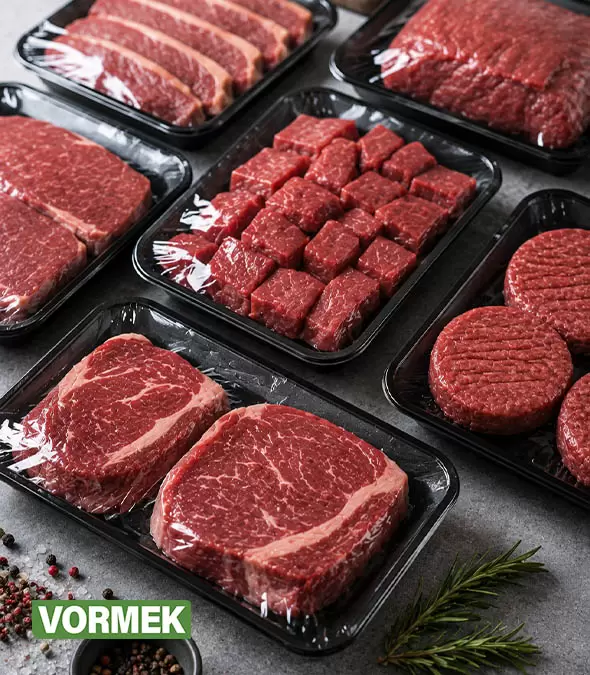
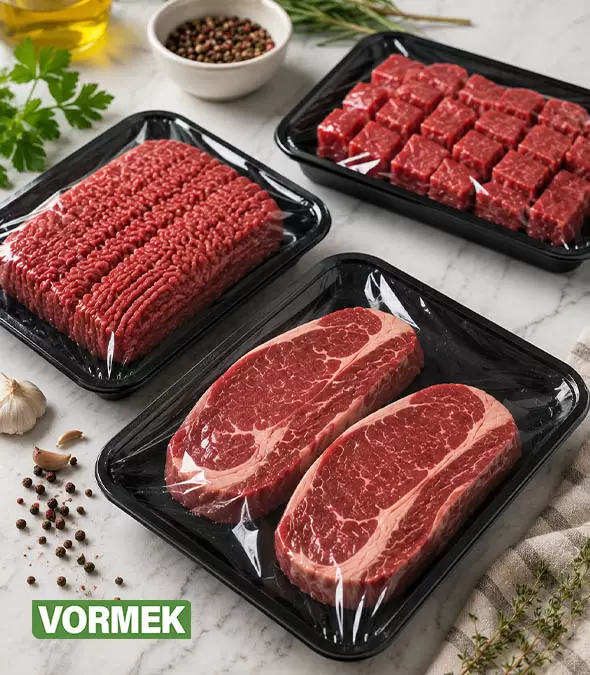
- Portioned cuts and steaks: Tray sealing with appropriate barrier films is preferred for retail presentation, maintaining the appearance that consumers expect. The controlled environment helps preserve product quality and visual appeal.
- Ground meat: Packaging with high barrier properties is effective for controlling microbial growth in this high-surface-area product. The high surface area of ground meat makes it particularly susceptible to spoilage, requiring careful material selection.
- Marinated or seasoned products: Packaging must be compatible with marinades and seasonings, which can affect seal integrity. The presence of oils, acids, and other ingredients in marinades can interfere with seal formation if not properly managed.
- Processed meat products: Form-fill-seal and thermoforming technologies are often used for high-volume production of sausages, cold cuts, and similar products. These technologies offer high efficiency and consistent quality for standardized products.
3. Expected Shelf Life
The required shelf life influences the choice of packaging technology and materials.
- Short shelf life: Conventional overwrap with oxygen-permeable film may be adequate for local distribution. This approach is simple and cost-effective but offers limited protection against spoilage and quality degradation.
- Medium shelf life: Vacuum packaging or tray sealing with appropriate barrier films is typically required. These technologies provide enhanced protection against oxygen and microbial growth, extending shelf life while maintaining quality.
- Extended shelf life: High-barrier packaging with superior films is necessary for export and extended distribution. These technologies offer the highest level of protection, allowing for long-distance transport and extended storage.
4. Target Market
- Domestic market: Products for domestic retail typically require good shelf life and attractive presentation, with less emphasis on extreme durability. The focus is on maintaining quality for the relatively short period between production and consumption.
- Export market: Export products require robust packaging that withstands longer transit times, temperature variations, and handling stresses. High-barrier packaging is preferred for these applications, with films that provide superior protection.
5. Tray and Film Types
The choice of containers or packaging films affects equipment compatibility and performance.
- Tray materials: PET, PP, APET, CPET, and aluminum are commonly used. Each material has different barrier properties, thermal resistance, and cost. PET offers good clarity and moderate barrier, while CPET provides heat resistance for retort applications.
- Film types: Films vary in oxygen barrier, clarity, sealability, and puncture resistance. The optimal film depends on product requirements and equipment capabilities. Common film structures include PE/EVOH/PE for high oxygen barrier, PA/PE for puncture resistance, and PET/PE for good clarity and moderate barrier.
6. Automation Level
The desired degree of automation affects both initial investment and ongoing labor costs:
| Automation Level | Labor Requirement | Initial Cost |
|---|---|---|
| Manual | High | Low |
| Semi-automatic | Moderate | Moderate |
| Fully automatic | Low | High |
| Robotic integration | Minimal | Very High |
7. Expansion Capability
Equipment should allow for future expansion of production capacity or product range. Modular designs are often preferable for this reason, enabling producers to add capacity or functionality as business grows. The ability to add additional lanes, integrate new features, or upgrade components without replacing the entire system provides significant long-term value.
8. After-Sales Support and Spare Parts
Reliable after-sales support is essential for maintaining production continuity. Factors to consider include:
- Local technical support availability
- Access to spare parts for critical components
- Comprehensive training programs for operators and maintenance staff
- Complete technical documentation
Detailed Analysis of Red Meat Packaging Technologies
Modified Atmosphere Packaging (MAP) for Red Meat
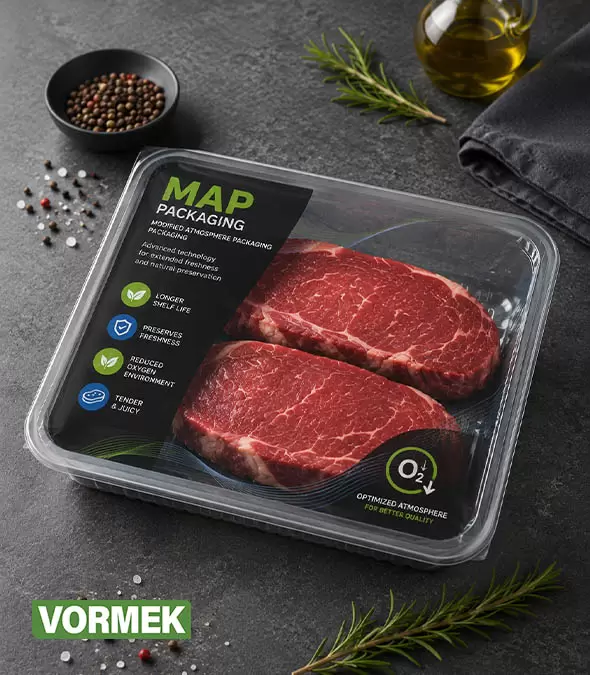
MAP is widely used for retail red meat packaging, offering excellent color retention and shelf life extension. The technology involves modifying the internal atmosphere of the package to create conditions that preserve product quality.
Advantages of MAP for Red Meat:
- Color retention: MAP helps maintain the desirable bright red color for extended periods through controlled oxygen levels. The presence of oxygen promotes the formation of oxymyoglobin, the bright red pigment that consumers associate with freshness.
- Extended shelf life: MAP can significantly extend shelf life when combined with proper cold chain management and appropriate packaging materials.
- Product visibility: Clear film allows consumers to see the product. This transparency is a key advantage for retail applications, where consumers evaluate product quality based on appearance.
- Reduced drip loss: MAP helps maintain product moisture by reducing moisture loss during storage.
- Flexibility: Adjustable gas mixtures allow tailoring to different product types. Different cuts, quality grades, and intended shelf lives can be accommodated through gas composition selection.
MAP requires specialized equipment and gas mixing systems. High-barrier films are required to retain the gas mixture, and precise sealing is essential for consistent results.
Vacuum Packaging for Red Meat
Vacuum packaging is widely used for primal cuts and export shipments where long shelf life is required.
Advantages of Vacuum Packaging:
- Extended shelf life: Vacuum packaging can significantly extend shelf life for fresh meat by removing oxygen and inhibiting aerobic spoilage organisms.
- Compact packaging: The tight film conforms to the product, reducing package size and shipping costs. This compactness improves logistics efficiency and reduces storage space requirements.
- Leak prevention: The hermetic seal prevents leakage and contamination. The integrity of the vacuum seal is critical for maintaining product quality and safety.
- Cost-effective: Generally less expensive than MAP for high-volume applications. Vacuum packaging equipment is typically less complex and less expensive than MAP equipment.
- Proven technology: Well-established with extensive industry experience. Vacuum packaging has been used for decades and is well-understood by processors and consumers.
Considerations for Vacuum Packaging:
- Color changes: The absence of oxygen causes meat to become dark purple or brown (deoxymyoglobin). While this does not indicate spoilage, some consumers may perceive it negatively. Educating consumers about this normal change is important for market acceptance.
- Drip loss: Pressure from the vacuum can force juices from the meat. This loss of moisture can affect product quality and yield.
- Deformation: Soft products may be deformed by vacuum pressure. This can affect the appearance and consumer appeal of the product.
Thermoforming with MAP for Red Meat
Thermoforming combines tray forming and gas flushing in a single, continuous operation, offering high efficiency for large-scale production.
How Thermoforming Works:
- Bottom film is heated and formed into trays.
- Meat portions are placed into the trays (manual or automatic filling).
- The trays enter the sealing station where the atmosphere is controlled.
- The top film is heat-sealed to the tray.
- Individual packages are cut and separated.
Advantages of Thermoforming for Red Meat:
- High throughput: Suitable for large-scale production with minimal labor. Thermoforming lines can produce thousands of packages per hour, making them ideal for high-volume operations.
- Material efficiency: Optimized film usage reduces waste. Thermoforming forms trays directly from film, minimizing material usage compared to pre-formed trays.
- Consistent quality: Uniform tray dimensions and seal quality. The automated nature of the process ensures consistent package quality.
- Automation: Complete automation from film forming to finished package. Thermoforming lines require minimal manual intervention, reducing labor costs and human error.
Considerations for Thermoforming:
- Thermoforming lines have higher capital costs than tray sealers. The investment in a thermoforming line is substantial but is justified by the high throughput and material efficiency.
- Changeover between different tray sizes takes longer compared to tray sealers. Producers with diverse product lines may find tray sealers more flexible.
Skin Packaging for Red Meat
Vacuum Skin Packaging (VSP) is a premium technology that combines the benefits of vacuum with an attractive presentation. The top film conforms tightly to the product, creating a “second skin” effect.
Advantages of Skin Packaging:
- Premium appearance: The tight film highlights the product’s natural shape and texture. This premium presentation is valued in high-end retail and foodservice applications.
- Excellent shelf life: Similar to vacuum packaging. The oxygen-free environment provides extended shelf life comparable to vacuum packaging.
- No drip loss: The tight seal prevents juice migration. This is a significant advantage for consumer convenience and product presentation.
- No package deformation: Products maintain their natural shape. The absence of vacuum pressure on the product prevents deformation.
Considerations for Skin Packaging:
- Skin packaging equipment is more expensive than standard vacuum packaging. The specialized equipment required for VSP represents a higher investment.
- Special films are required for vacuum skin applications. These films are designed to conform to the product and provide the required barrier properties.
- Products with irregular shapes may require support materials. Irregularly shaped products may need additional support to maintain package integrity.
Critical Success Factors in Red Meat Packaging
Cold Chain Integrity
Maintaining the cold chain is the single most important factor in red meat packaging success. Even the best packaging cannot compensate for temperature abuse.
Cold chain requirements:
- Processing temperature: Meat should be properly chilled before packaging. Proper chilling before packaging is essential for achieving the required shelf life.
- Packaging temperature: Packaging should be performed in a refrigerated environment. Maintaining cold temperatures during packaging minimizes the risk of quality degradation.
- Storage temperature: Finished packages must be stored at appropriate refrigerated temperatures. Consistent refrigeration throughout storage is essential for preserving quality.
- Transport temperature: Refrigerated transport must maintain appropriate temperatures. Temperature monitoring during transport is essential for verifying cold chain integrity.
- Retail display: Refrigerated display cases must be maintained at appropriate temperatures. Retail display conditions must be monitored to ensure product quality is maintained.
Consequences of temperature abuse:
- Reduced shelf life: Even brief temperature excursions can have a significant impact on product quality.
- Condensation: Temperature fluctuations cause moisture condensation inside the package. This condensation can promote microbial growth and affect product appearance.
- Color changes: Temperature abuse accelerates oxidation and color changes. The bright red color of meat is particularly sensitive to temperature fluctuations.
- Microbial growth: Bacterial growth accelerates significantly above optimal temperatures. The rate of microbial growth increases with temperature.
Film and Material Selection
The choice of packaging films directly affects product quality, shelf life, and package integrity.
Key film properties for red meat packaging:
- Oxygen barrier: High oxygen barrier films are essential for extended shelf life. The oxygen transmission rate (OTR) must be low enough to maintain the desired conditions and prevent oxidative rancidity.
- Water vapor barrier: Moisture barrier prevents weight loss and maintains product quality. The water vapor transmission rate (WVTR) must be controlled to prevent excessive moisture loss.
- Clarity: High clarity films allow product visibility, a key factor in retail appeal. Good optical properties are essential for consumer acceptance.
- Seal strength: Strong seals prevent leakage and package failure. Seal integrity must be maintained throughout the product’s shelf life.
- Puncture resistance: Resistance to punctures protects the package during handling and distribution. Meat products often have bones or sharp edges that can damage packaging.
- Shrink properties: For vacuum skin applications, films with specific shrink properties are required. Controlled shrinkage ensures a tight, wrinkle-free package.
- Printability: Films that accept high-quality printing enhance branding and label legibility. The ability to print directly on the film provides branding opportunities.
Common film structures for red meat:
- PE/EVOH/PE: High oxygen barrier suitable for extended shelf life applications.
- PA/PE: Moderate barrier with good puncture resistance.
- PET/PE: Good clarity and moderate barrier.
- PE/PVdC/PE: Very high barrier for demanding applications.
- PA/EVOH/PE: Superior barrier for critical applications.
Quality Control and Monitoring
Robust quality control is essential for maintaining consistent packaging quality.
In-process controls:
- Seal integrity: Regular seal testing to verify strength and integrity. Seal failures are a leading cause of product defects.
- Temperature: Continuous temperature monitoring throughout the process. Temperature control is essential for quality preservation.
- Film quality: Inspection of film for defects, contamination, and proper handling. Film defects can compromise package integrity.
Finished product testing:
- Package integrity testing: Testing to verify the package remains sealed and provides the intended barrier.
- Color measurement: Objective measurement of meat color to ensure consistent appearance.
- Microbiological testing: Sampling and testing to verify product safety.
- Sensory evaluation: Testing of appearance, aroma, texture, and flavor.
Expert Perspective on Red Meat Packaging
Industry experience demonstrates that extending the shelf life of red meat is not achieved through equipment selection alone. Optimal results require coordination among multiple factors:
- Product quality: Starting with high-quality raw materials is essential.
- Packaging technology: Equipment must be appropriate for the product and production volume.
- Film selection: The right film must be chosen for the specific application.
- Cold chain management: Temperature control must be maintained throughout the supply chain.
- Process parameters: Sealing temperature and pressure must be correctly set and monitored.
- Hygiene standards: Strict hygiene must be maintained throughout processing and packaging.
For these reasons, it is strongly recommended that producers conduct technical trials and evaluate real production conditions before selecting equipment. This approach ensures that the most suitable solution is identified for each specific product and application.
A comprehensive trial program should include:
- Product characterization: Understanding the specific quality attributes and preservation needs of the product.
- Material evaluation: Testing different film and tray combinations to identify optimal performance.
- Process optimization: Adjusting equipment parameters to achieve consistent quality.
- Shelf life studies: Monitoring product quality over time under expected storage conditions.
- Distribution simulation: Testing package performance under simulated distribution conditions.
- Consumer evaluation: Assessing consumer acceptance of the packaged product.
Frequently Asked Questions About Red Meat Packaging
1. Why does meat color become darker in some packaging?
The color of meat is influenced by the oxygen level in the package. Oxygen reduction can cause darker color, which does not necessarily indicate spoilage. In vacuum packaging, this is a normal and expected change.
2. What factors most affect meat shelf life?
- Initial product quality
- Cold chain integrity
- Packaging type
- Film quality
- Hygiene control during production
3. What is the optimum temperature for red meat packaging?
Fresh red meat should be packaged at refrigerated temperatures. Packaging at higher temperatures increases microbial growth and reduces shelf life. Many producers package meat immediately after chilling for best results.
4. How does cold chain affect meat packaging?
Temperature fluctuations can cause condensation, accelerate microbial growth, and cause color changes. Proper cold chain management is essential for maintaining optimal product quality.
5. What are the critical quality factors in red meat packaging?
The critical quality factors include temperature control throughout the supply chain, oxygen barrier to prevent oxidation and color changes, moisture retention to prevent weight loss, seal integrity to prevent leakage and contamination, and material compatibility.
6. How does film selection affect meat quality?
Film selection affects oxygen barrier, moisture retention, clarity, and seal integrity. The correct film selection is essential for achieving the required shelf life and product presentation.
7. What is vacuum skin packaging?
Vacuum Skin Packaging (VSP) is a premium technology where the top film conforms tightly to the product, creating a “second skin” effect. This provides excellent shelf life and a premium appearance.
8. Why is cold chain integrity important for meat packaging?
Cold chain integrity is essential because temperature abuse accelerates quality degradation, causes condensation, promotes microbial growth, and leads to color changes. Even the best packaging cannot compensate for temperature abuse.
9. What are the common challenges in red meat packaging?
Common challenges include oxidation and color changes, microbial spoilage, moisture loss, temperature sensitivity, fat oxidation, and maintaining seal integrity.
10. How should meat be handled before packaging?
Meat should be properly chilled, trimmed of excess fat and visible contamination, and handled with strict hygiene. Pre-packing processes should be performed in a refrigerated environment.
Conclusion
Red meat packaging is a complex discipline requiring careful consideration of product characteristics, distribution requirements, regulatory compliance, and market positioning. The selection of appropriate packaging equipment and materials directly influences product quality, safety, shelf life, and commercial success.
Key takeaways for red meat producers:
- Packaging is a strategic investment: Beyond its protective role, packaging is a powerful tool for quality preservation and brand building. Investment in packaging should be viewed as a strategic investment in product value.
- Technology choice matters: The selection of tray sealing, thermoforming, vacuum, or skin packaging depends on product type, volume, and market requirements. Careful evaluation leads to the best outcome.
- Cold chain is non-negotiable: Temperature control throughout processing, packaging, storage, and transport is essential for maintaining quality and safety. Any break in the cold chain compromises product quality.
- Film selection is critical: The choice of packaging films affects oxygen barrier, moisture retention, clarity, and seal integrity. The correct film selection is essential for achieving the required shelf life and product presentation.
- Quality control is essential: Robust quality control programs ensure consistent packaging quality and product safety. In-process monitoring and finished product testing prevent costly quality failures.
- Expert guidance is valuable: Packaging expertise can help producers avoid costly mistakes and identify optimal solutions for specific products and markets.
Vormek offers advanced packaging solutions for the red meat industry, including tray sealer systems, thermoforming lines, and vacuum packaging equipment. Our systems are engineered for precision, reliability, and hygiene, enabling producers to deliver high-quality products that meet demanding market expectations. Contact our engineering team to discuss your red meat packaging requirements.